
December has a habit of producing big moments in computing just before the Christmas break. The month gave us the transistor, the first public view of a computer mouse, and two deals that reshaped the PC industry. Here are four anniversaries, in date order.
7 December 2004: IBM sells its PC business to Lenovo
IBM helped create the personal computer industry in 1981. I remember working on old IBM PCs in my first job! But that heritage was left behind on 7 December 2004 when IBM announced it was selling its PC division to Lenovo. At that time, Lenovo was China’s largest PC maker. Lenovo agreed to pay US$1.25 billion, made up of US$650 million in cash and US$600 million in shares, and to take on US$500 million of IBM debt. The deal had taken 13 months to negotiate.
Overnight, Lenovo went from eighth place among the world’s PC makers to third, according to Gartner, behind Dell and Hewlett-Packard. It took ownership of IBM’s Think brands, including the ThinkPad, and could keep using the IBM logo for up to five years. Around 10,000 IBM staff moved across, and IBM ended up with an 18.9% stake in Lenovo. For IBM, the sale meant concentrating on services, software and servers, where the margins were better. The deal completed on 3 May 2005. ThinkPads are still a common sight in offices today, now under the Lenovo name. In fact, I’m writing this on my Lenovo Thinkpad!
9 December 1968: The mother of all demos
On 9 December 1968, Douglas Engelbart of the Stanford Research Institute (SRI) gave a 90-minute live demonstration at the Fall Joint Computer Conference in San Francisco. About 1,000 computer professionals were in the Civic Auditorium to watch.
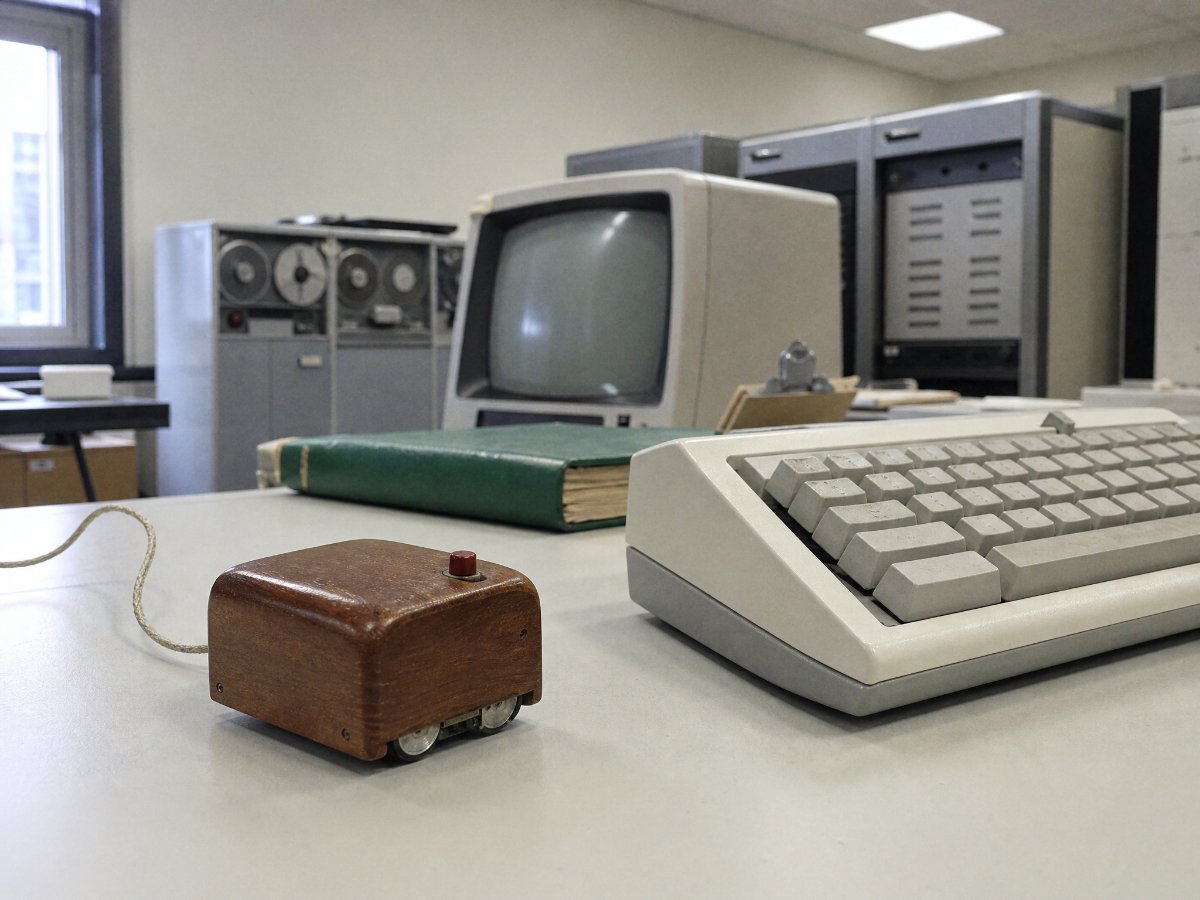
What they saw was a system called NLS, the oN-Line System, built by Engelbart’s Augmentation Research Center. In one session it showed windows, hypertext links, word processing, video conferencing, real-time collaborative editing and a small hand-held pointing device that came to be called the mouse. The computer itself was back at SRI’s headquarters in Menlo Park, connected to the stage by homemade 1,200 baud modems over a leased line, with two microwave links carrying live video between the lab and the hall.
The mouse had been built in 1964 by SRI engineer Bill English. Engelbart’s patent for an “X-Y Position Indicator for a Display System” was filed in 1967 and granted in 1970. The demonstration influenced work at Xerox PARC in the early 1970s, and through that the graphical interfaces of the Apple Macintosh and Microsoft Windows. It only later picked up the name “the mother of all demos“.
16 December 1947: The first transistor
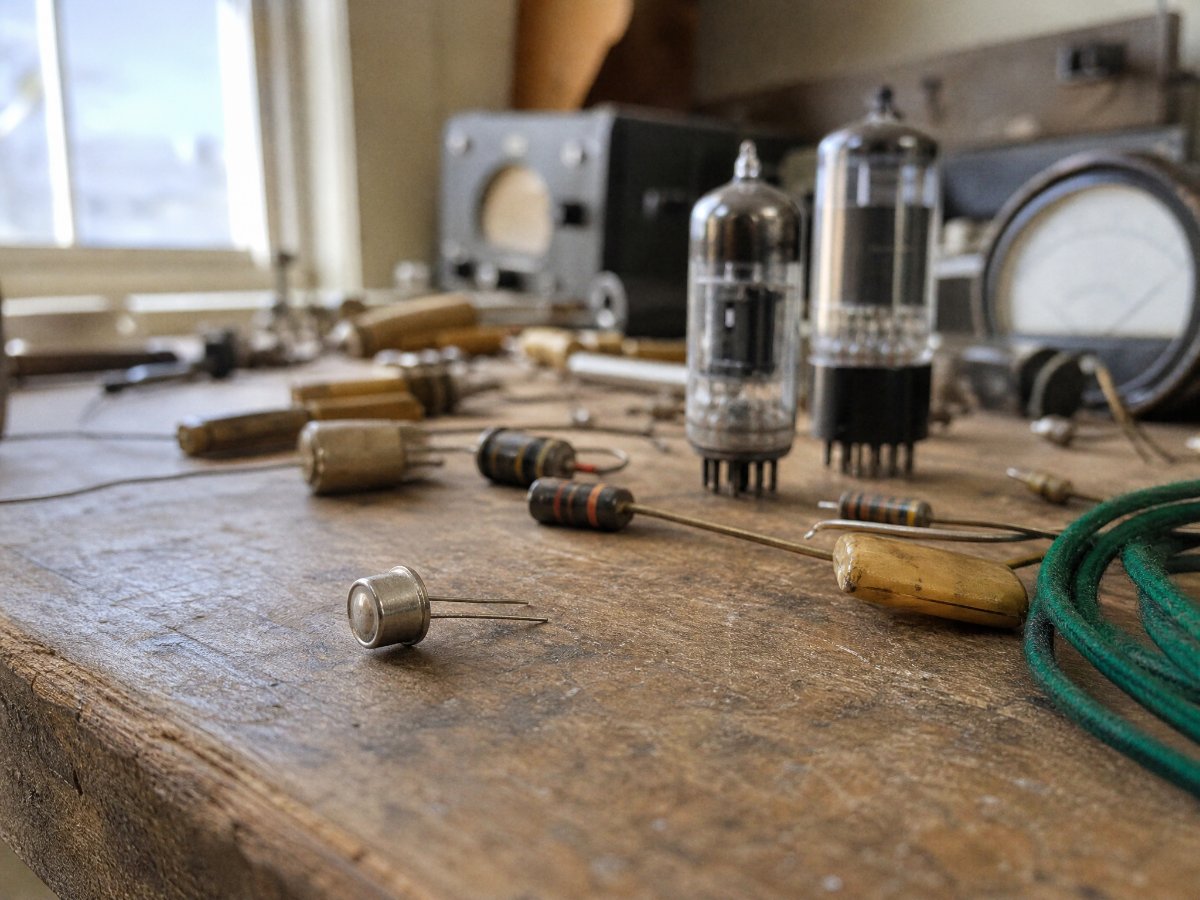
At Bell Labs, physicists John Bardeen and Walter Brattain had spent months studying how electrons behave on the surface of semiconductors. On 16 December 1947 they got it to work. Two closely spaced gold contacts, held in place by a plastic wedge, were pressed onto a small slab of high-purity germanium. A voltage on one contact controlled the current through the other, amplifying the signal up to 100 times.
They showed the device to Bell Labs management on 23 December. William Shockley, who led the group, called it “a magnificent Christmas present”. Engineer John Pierce came up with the name transistor, and Bell Labs announced it publicly on 30 June 1948. Shockley, Bardeen and Brattain shared the 1956 Nobel Prize in Physics for the work. Every processor in every device in your office is built from billions of descendants of that germanium slab.
20 December 1996: Apple buys NeXT
On 20 December 1996, Apple announced it would buy NeXT Software for US$400 million. NeXT had been founded in 1985 by Steve Jobs, after he was pushed out of Apple. Its computers never sold well and it had sold off its hardware business in 1993, but its NeXTSTEP operating system had a strong reputation.
The deal closed in 1997. NeXTSTEP became the foundation of every Apple operating system that followed, and macOS can still trace its roots to it. The deal also brought Jobs back. He returned reporting to then chief executive Gil Amelio, was interim chief executive by September 1997, and dropped the “interim” in 2000.